Publication Etics

Publication Ethics
(Edu Society: Jurnal Pendidikan, Ilmu Sosial dan Pengabdian kepada Masyarakat)

Edu Society is committed to upholding the highest standards of publication ethics and taking all necessary measures to prevent publication malpractice. All parties involved in the publishing process—editors, authors, reviewers, and the publisher—are expected to adhere to the following ethical principles, which are based on the guidelines provided by the Committee on Publication Ethics (COPE).

General Ethics in Journal Publishing

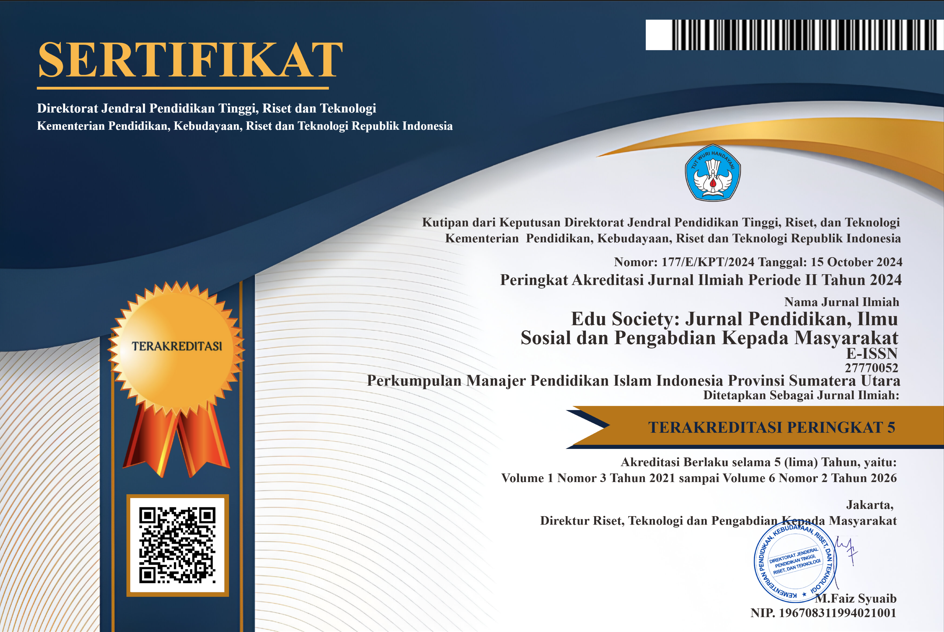
  1. Clearly state the journal’s name, scope, publication frequency, and accreditation status.
  2. Transparently disclose the composition and expertise of the editorial board.
  3. Establish ethical and professional relationships among authors, editors, reviewers, the publisher, and other stakeholders.
  4. Ensure the confidentiality of all involved parties, including authors, editors, reviewers, and research contributors.
  5. Respect intellectual property rights, particularly regarding copyright and licensing.
  6. Communicate editorial policies to all stakeholders (authors, the editorial board, reviewers, and readers).
  7. Provide a clear code of ethics for editors and peer reviewers.
  8. Publish each issue consistently and in a timely manner.
  9. Ensure the availability of adequate resources for the sustainability of the publication.
  10. Develop collaborative networks and strategies for the dissemination of the journal.
  11. Manage all legal and licensing aspects appropriately and transparently.

Duties of Peer Reviewers

  1. Commit to continuously improving publication standards.
  2. Ensure the scientific quality and integrity of published articles.
  3. Uphold the academic freedom of authors and their right to express ideas.
  4. Safeguard the integrity of the academic record and the reputation of authors. 5. Facilitate corrections, clarifications, retractions, and apologies when necessary.
  5. Affirm that the content and statements within a manuscript are the sole responsibility of the author(s).
  6. Evaluate submitted manuscripts objectively and fairly—regardless of the author’s race, gender, religion, nationality, institutional affiliation, or political views—to avoid bias and editorial errors.
  7. Avoid conflicts of interest and ensure editorial independence.
  8. Encourage authors to refine their manuscripts prior to publication.
  9. Maintain transparency, accountability, and fairness throughout the editorial process.

Duties of Peer Reviewers

  1. Evaluate manuscripts objectively and in accordance with academic standards. Review submissions in a timely and professional manner, and decline review invitations if the topic falls outside their area of ??expertise or if they are unable to meet the deadline.
  2. Provide constructive and useful feedback to assist in the improvement of the manuscript.
  3. Maintain the confidentiality of the manuscript and the review process, and refrain from using unpublished content for personal gain or for the benefit of third parties.
  4. Decline to conduct a review if a conflict of interest—whether direct or indirect—exists.
  5. Adhere to the review criteria and procedures established by the journal.
  6. Focus on aspects such as originality, significance, clarity, and contribution to the relevant field, rather than concentrating solely on grammar or typographical errors (unless such errors impede comprehension).
  7. Provide honest, clear recommendations supported by sound reasoning—such as: accepted without revision; accepted with minor revisions; major revisions required (necessitating a re-review); or rejected with a suggestion for resubmission. or rejected due to scientific or ethical flaws.

Duties of Authors

  1. Authors bear full responsibility for the content, methodology, analysis, calculations, and conclusions presented in their manuscripts.
  2. Manuscripts must be original, previously unpublished, and not currently under consideration by any other journal.
  3. Citations must accurately refer to the sources used and include only works that have been consulted; prior research must be duly acknowledged.
  4. Appropriate permissions and acknowledgments must be obtained for any copyrighted material.
  5. Authors are required to honestly disclose the limitations of their research and state whether the article is part of a broader or multi-stage study.
  6. Authors must respond to reviewers' comments efficiently and professionally, and notify the editor if they decide to withdraw a manuscript.
  7. Authors are prohibited from disseminating research content through media outlets or interviews prior to its official publication.
  8. Authors must provide supporting documentation (such as field notes or ethical approval) if requested.
  9. Authors must inform the editor if any significant errors are discovered after publication and respond to post-publication inquiries in a responsible manner.

Plagiarism and Similarity Checks 

  1. Every manuscript is screened using plagiarism-detection software before being sent to reviewers and again prior to publication. The maximum acceptable similarity index is 25%.
  2. Manuscripts exceeding this threshold will be returned to the authors for revision or rejected.
  3. Plagiarism includes the copying of text, data, or ideas without proper citation, redundant (duplicate) publication, and self-plagiarism involving previously published work.
  4. Plagiarism discovered after a manuscript has been published will be addressed through correction and retraction procedures, as outlined below.

Conflict of Interest

  1. Authors are required to disclose any financial or personal relationships that could influence their work, including sources of funding.
  2. Editors and reviewers must declare any conflicts of interest and recuse themselves from the handling or review process of manuscripts in which they have such a conflict.

Use of Artificial Intelligence (AI)

  1. AI tools cannot be listed as authors, as they cannot be held accountable for the work.
  2. Authors who use AI tools for language editing or data analysis must disclose this in the methodology or acknowledgments section; they remain fully responsible for the accuracy and originality of the content.
  3. Reviewers and editors are prohibited from uploading manuscripts under review to public AI services to ensure confidentiality.

Corrections, Retractions, and Expressions of Concern

  1. Reporting. Concerns regarding published articles (such as errors, plagiarism, data fabrication, or redundant publication) may be raised by authors, readers, or reviewers by contacting the editor via email at skipi@umko.ac.id.
  2. Investigation. The editor will conduct an investigation following the COPE flowcharts and request clarification from the author(s).
  3. Decision. Based on the findings, the editor may issue a correction (for unintentional errors that do not invalidate the research results), an expression of concern (while an investigation is ongoing), or a retraction (in cases of serious ethical misconduct or invalid research results).
  4. Publication of Notice. Retracted articles will remain available online, clearly marked as retracted, with a link to a retraction notice explaining the reason for the retraction.
  5. Proven ethical misconduct may result in the rejection or retraction of the author’s manuscript, as well as a prohibition on submitting future manuscripts to this journal for a period determined by the editorial board.

Disclaimer
The views and conclusions expressed in published articles are the sole responsibility of the authors. The editorial board assumes no liability for any copyright infringement committed by the authors.